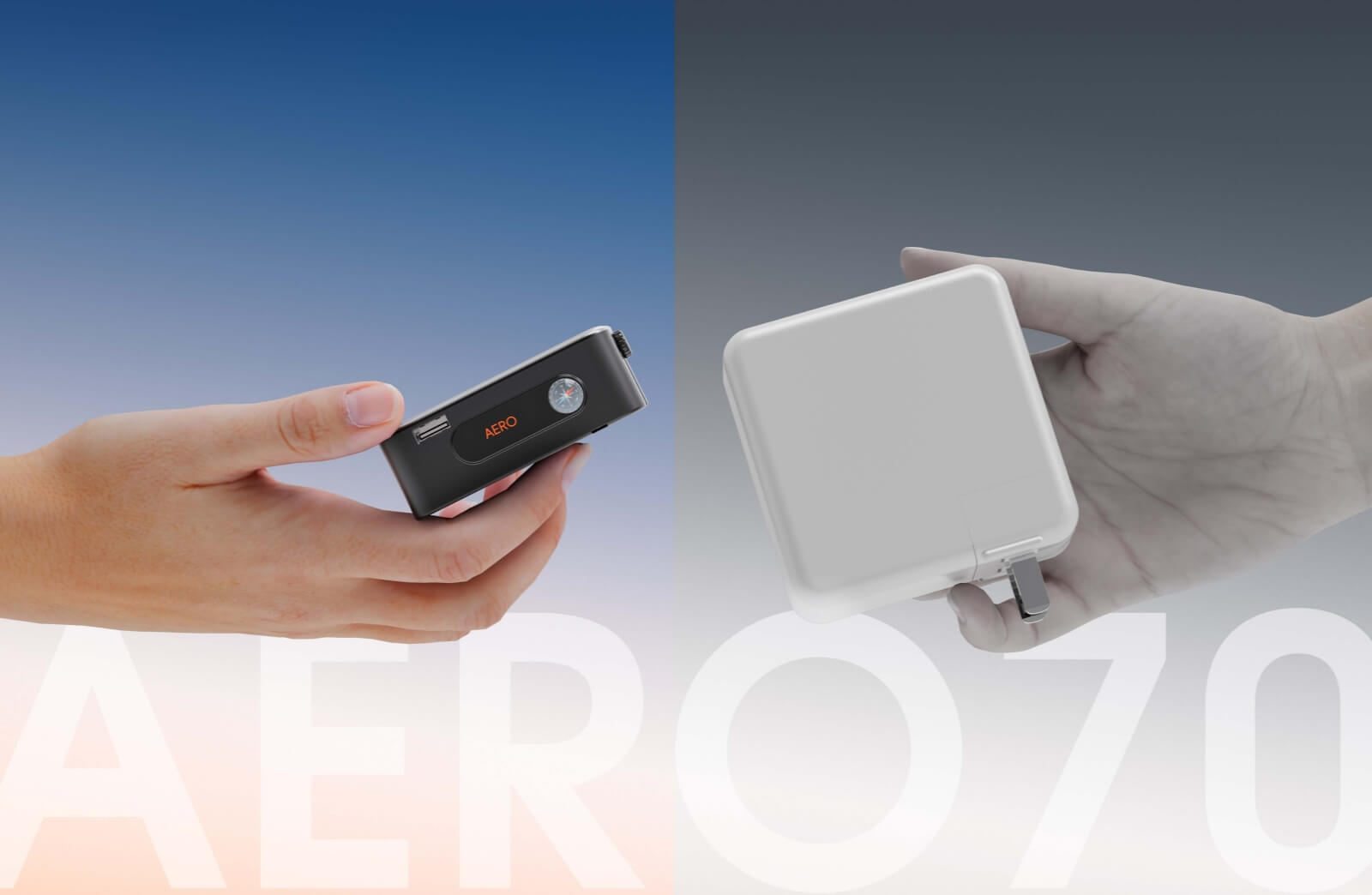

In our previous article - Beyond a Tool: Meet AERO 70, Designed for the Way We Travel Today, we explored how the nature of travel has fundamentally shifted — lighter, faster, freer. We also surfaced a central contradiction: the philosophy of travel has evolved, but the philosophy of charging remains anchored in the last decade.
Today, we want to pull that contradiction open one layer deeper.
Not to stir unease — but because when an entire industry quietly sidesteps its own shortcomings for too long, the ones who pay the price are always the people who depend on it.
Three Silent Failures of the Traditional Travel Adapter
Let's start with an honest look at an uncomfortable fact: the charging adapters most travelers carry today are, in their fundamental design logic, virtually indistinguishable from what existed ten years ago.
Their shared traits can be captured in three words: Bulky. Limited. Blind.
Bulky
Conventional adapters are typically built on silicon-based power components — inherently large, heat-prone, and noticeably heavy. For the modern traveler striving to move light, these devices consume more than just physical space in a bag. They impose a kind of psychological weight — the quiet frustration of having to plan around a tool that should, by all rights, be invisible.
Limited
Most traditional adapters still ship with port configurations frozen in the single-USB-A or single-USB-C era. When today's traveler needs to charge a laptop, a phone, earbuds, and a tablet simultaneously, these devices simply cannot keep up. The workaround — packing a power strip or multiple charging bricks — directly contradicts the promise of traveling lean.
Blind
This is the most overlooked flaw, and perhaps the most consequential. Traditional adapters offer zero real-time feedback. You cannot see the current output wattage. You cannot confirm whether your device is fast-charging or trickle-charging. You cannot verify whether the voltage is stable and safe. Every time you plug in, you are, in effect, charging blind.
This blindness may be tolerable within a single, familiar electrical grid. But the moment you cross a border — navigating voltage standards that swing from 110V to 240V, plugging into power infrastructure of unpredictable quality — that uncertainty is no longer just an inconvenience. It becomes a genuine risk.
The Truth the Industry Won't Say Out Loud: Most People Are Charging Blind
Let's be more candid still.
The dominant design philosophy across the travel charging industry today remains strikingly simplistic: just get the power in. The question these products answer is "Can it charge?" — not "Is it charging well?" The concern is "Does it have a port?" — not "Is this charging session transparent and controllable?"
But for today's traveler — someone carrying thousands of dollars in electronics, relying on those devices for work, wayfinding, and staying connected to the people who matter — "it's charging" is no longer sufficient. They need to know:
What's the current wattage? Has fast charging actually engaged?
Is the voltage stable? Are there fluctuations that could damage my gear?
With multiple devices plugged in, how is power being distributed? Is my laptop silently throttled to a crawl without my knowledge?
Traditional adapters never answer these questions.
Not because the answers are unimportant — but because these devices are simply incapable of providing them.
GaN (Gallium Nitride): Not Just "Smaller" — A Reinvention of the Foundation
To truly grasp the distance between AERO 70 and conventional adapters, you first need to understand a pivotal technological divide: GaN (Gallium Nitride) semiconductor technology.
Traditional chargers rely on silicon-based (Si) power transistors — a technology that is mature but has reached its physical limits. To deliver more power, you must accept more bulk and more thermal management hardware. This is the root cause of the old rule: more power always means more weight.
GaN, a third-generation semiconductor material, shatters that equation. It offers higher electron mobility, superior thermal conductivity, and dramatically lower energy loss. In real-world terms, this means:
At equivalent wattage, device volume can shrink by 40–60%.
Heat generation drops significantly, eliminating the need for bulky cooling structures.
Conversion efficiency climbs, so less energy is wasted.
This is not a marginal refinement. It is a generational leap in the underlying physics of how power is delivered.
TESSAN AERO 70 is engineered on a GaN technology platform — enabling 70W of charging capability without the traditional penalty in portability. For the first time, power and lightness genuinely coexist within a single device built for the road.
Smart Digital Display: From Charging Blind to Charging in Full View
If GaN resolves the tension between size and performance, the smart digital display addresses something even more fundamental — the transparency of the charging process itself.
AERO 70's real-time display panel transforms charging from an opaque, trust-and-hope operation into a clear, tangible, controllable experience:
Live Wattage Readout: See the exact output of each port at a glance. Confirm instantly whether fast-charge protocols have engaged.
Voltage Status Monitoring: When plugging in overseas, know your input voltage conditions immediately — no guesswork, no anxiety.
Multi-Device Power Allocation View: When several devices draw power simultaneously, watch in real time how wattage is distributed — ensuring your most critical device always receives priority.
This is not a "nice-looking screen." It is a philosophical shift: charging should be transparent, and users have every right to see where each watt is going.
Picture this: you're in a hotel room in an unfamiliar country, connecting expensive equipment to an electrical grid you know nothing about. A display that calmly confirms "Everything is running as it should" delivers more than data. It delivers peace of mind.
This Is Not a Spec Upgrade. This Is a Standard Redefined.
Let's step back to the wider view.
The travel charging industry has remained stagnant not because better solutions were technically impossible, but because the industry grew comfortable with a "good enough" mindset: if it charges, ship it; if it converts, it works; if it functions, why rethink it?
But between "it works" and "it works beautifully" lies an entire generation of unmet expectations.
What AERO 70 represents is not a simple product refresh. It represents TESSAN's fundamental rethinking of the standard this category should be held to:
A travel charger should never be a burden you "have to bring." It should be so light you forget it's there.
Charging should never be a gamble of "plug in and pray." It should be transparent and controllable from beginning to end.
Cross-border compatibility should never be homework you do before a trip. It should be an obvious, built-in given.
Bulky can be solved. Limited can be surpassed. Blind can be ended.
AERO 70 exists as the most concrete proof of that conviction.
TESSAN's Promise: Let Every Traveler See Every Watt
In our first article, we said: TESSAN is not a charger brand — we are a Charging Solution brand. Our mission is Charging Your Home and Journey — making power a seamless part of life and travel, never a source of friction on the road.
Today, we want to deepen what that statement truly means:
"Seamlessly integrated" does not only mean smaller and lighter. It also means more transparent, more intelligent, and more worthy of your trust.
A truly great travel companion doesn't just work silently at the bottom of your bag. It should, in the moments when you need reassurance, speak clearly: "Everything is exactly as it should be. Go ahead — continue your journey."
That is what AERO 70 delivers.
And that is TESSAN's promise to every traveler:
Your journey deserves a better power experience. Your devices deserve to be charged intelligently. Every single charge you make deserves to be seen.
Travel Light. Stay in Control.