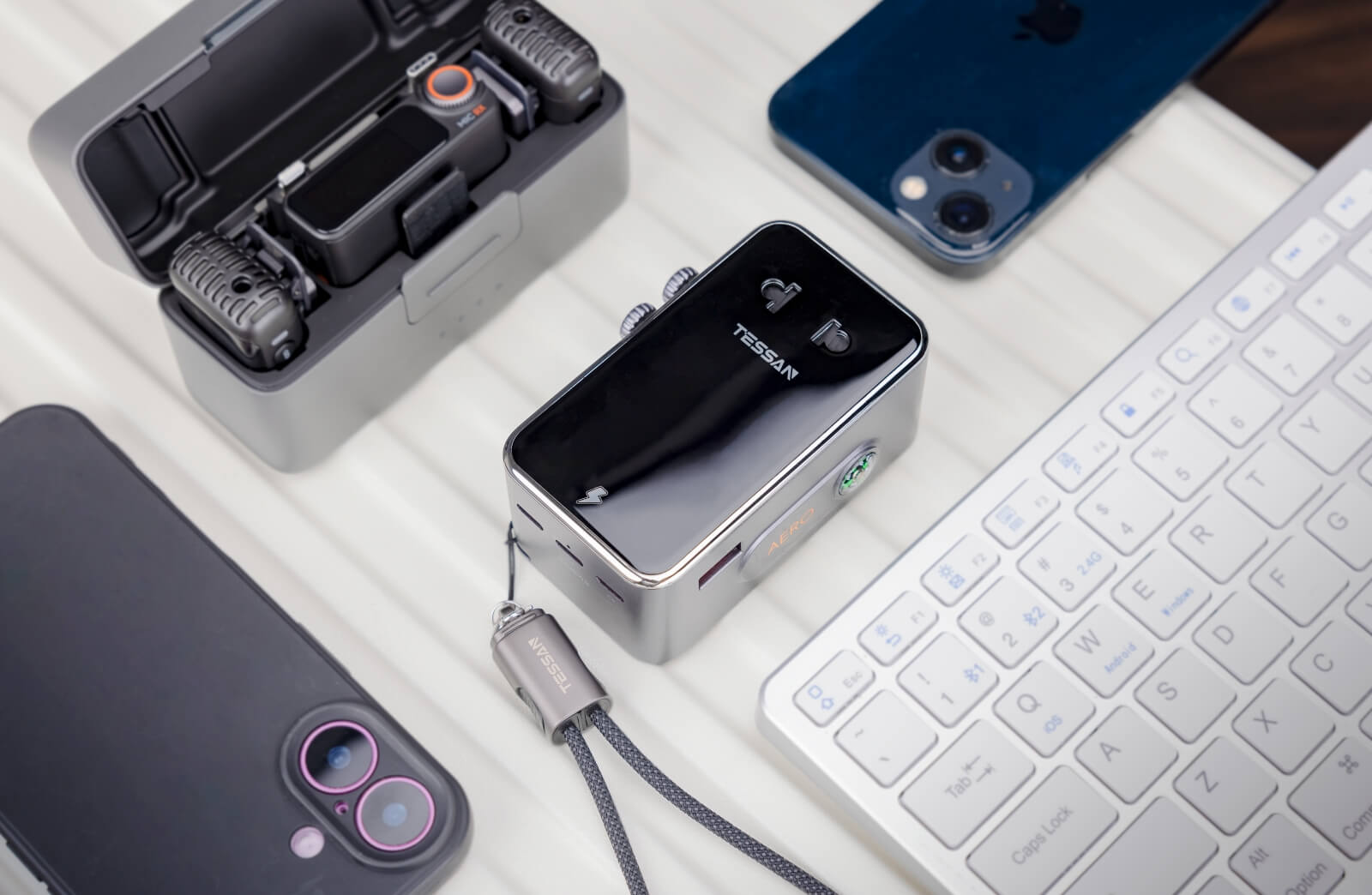

Why serious travelers don't just ask "does it charge?" — they ask "how does it protect?"
The Safety Conversation Most Brands Skip
If you're the kind of traveler who insures your camera body, researches hotel power infrastructure before booking, or travels with a portable UPS — this article is for you.
When your carry-on holds 10,000 in electronics — a MacBook Pro, a mirrorless camera system, noise-cancelling headphones, and a flagship phone — "it probably works fine" doesn't cut it as a safety standard. You need certainty. You need visibility. You need a universal travel adapter that does more than just bridge plug shapes.
We've covered AERO 70's smart display and monitoring system in earlier posts. Today, we're going a layer deeper — into the engineering decisions underneath. Not what the colors mean, but why they exist. Not what the screen shows, but why showing it matters more than hiding it.
This is for travelers who read spec sheets, ask hard questions, and expect their tools to earn trust through transparency — not through marketing language.
Why Passive Protection Isn't Enough Anymore
Every travel adapter on the market ships with some version of safety certification. Overcurrent protection. Short-circuit cutoff. Overvoltage shutdown. These are regulatory requirements — the bare minimum to sell a product, not a reason to choose one.
They're also entirely reactive. Something goes wrong, the circuit breaks, the device shuts down. Think of it as a seatbelt — essential, but it only engages after the collision has begun.
What's missing from most adapters — even expensive ones — is continuous awareness. The ability to monitor electrical conditions in real time, identify developing problems before they reach dangerous thresholds, and communicate that information clearly enough for you to make informed decisions.
This is what separates a smarter travel adapter from a basic one. AERO 70 was built on a fundamentally different premise: safety should be proactive, visible, and continuous — not a hidden failsafe you hope never triggers.
Automatic Voltage Identification: Reading the Room Before You Plug In
The moment AERO 70 connects to any outlet worldwide, it performs an instantaneous electrical assessment. Not a fixed assumption based on plug shape. Not a manual voltage switch you need to remember to flip. A real-time reading of actual incoming voltage and AC maximum load capacity for that specific circuit.
Why does this matter? Because the world's electrical infrastructure is far less standardized than most people assume:
- A country's nominal voltage doesn't guarantee what any individual outlet actually delivers
- Aging buildings, overloaded circuits, and unstable grids create fluctuations that plug-shape adapters can't detect
- The same hotel room can deliver different effective voltage depending on time of day and total building load
AERO 70 displays this information immediately — not buried in a menu, not requiring a button sequence, but as a persistent reading visible at every glance. Before you connect a single device, you know what you're working with.
For the business traveler bouncing between a modern conference center in Singapore and a converted heritage hotel in Lisbon, this kind of environmental intelligence isn't a luxury. It's the difference between charging with confidence and charging on faith.
Three-Color Current Monitoring: The Engineering Logic
We introduced the blue-yellow-red system in an earlier article as a visual language. Here's the engineering rationale — because understanding why these thresholds exist reveals how much thought went into them.
Blue — Normal Operation (≤10A)
Operation well within safe margins for virtually any residential or hotel circuit worldwide. Your connected devices are drawing power comfortably, with significant headroom — the gap between current load and maximum safe capacity. Headroom is where safety lives. Blue means you have plenty of it.
Yellow — Predictive Warning (11–12A)
This isn't a failure state. It's a heads-up. The system detects that load is approaching the upper boundary of typical residential circuit ratings in many countries. AERO 70 is telling you: "Everything still works, but you're drawing significant current. Worth a quick check."
Most electrical incidents don't happen at the exact point of failure. They develop in the gray zone between "normal" and "critical" — where conventional adapters give you zero visibility. AERO 70 illuminates that zone before problems materialize.
Red — Critical Alert (≥13A)
Current draw exceeds safe continuous operation for many outlet configurations worldwide. This is the clear signal to act — disconnect a high-draw device or remove the adapter from the outlet.
The critical design choice: this alert fires while you still have time to respond. It's not a post-failure notification. It's a pre-failure intervention — giving you decision-making space that reactive-only systems physically cannot provide.
For the tech-forward traveler or digital nomad running a laptop, monitor, and multiple devices from a single outlet in a co-working space abroad, this predictive layer is the difference between a normal Tuesday and a tripped breaker in a room full of strangers.
Thermal Intelligence: Borrowed from Aerospace, Built for Travel
Heat degrades components, reduces charging efficiency, and shortens product lifespan. Every charger generates it. The engineering question is: what do you do about it?
The conventional approach: build in thermal shutdown. Charger overheats, it stops. You lose power delivery without warning, wait for cooldown, and wonder what happened.
AERO 70's approach: continuous thermal sensing with proactive load balancing — adjusting power delivery in real time, long before shutdown thresholds are ever approached. The same philosophy used in aerospace thermal management systems: continuous monitoring, continuous adjustment, elimination of reactive-only failure modes.
The system communicates thermal state through its own three-color indicator:
Green — Cool Operation
Well within thermal envelope. Components unstressed. Typical during light loads or moderate ambient temperatures.
Blue — Active High-Efficiency
Normal during multi-device charging or sustained high-wattage delivery. The system is performing productive work, generating proportional heat, all within designed parameters.
Orange — Peak Performance
Maximum output engaged. The thermal management system is actively balancing power delivery against heat dissipation — sustaining top performance without approaching stress thresholds.
The key: you can see this happening. At any moment, a glance confirms your devices are charging and that the system managing that charge is operating within its designed thermal parameters. For a product this thin — and yes, AERO 70 remains the thinnest travel adapter in its class at just 1.4cm — thermal transparency isn't just nice to have. It's essential evidence that slim design hasn't compromised thermal safety.
TFFC 2.0: Safety at the Protocol Layer
Safety doesn't stop at voltage and temperature. It extends into the protocol negotiation layer — the invisible handshake between charger and device that determines how much power flows, at what voltage, and through which delivery standard.
Get this wrong, and the consequences are real but subtle: excess heat at the battery, accelerated cell degradation, reduced long-term capacity. Not dramatic failures — slow, invisible damage that compounds over months of travel.
TESSAN's proprietary TFFC 2.0 (Full Scene Fast Charging Technology) addresses this directly. As the world's first universal travel adapter supporting Apple's AVS protocol — arriving with iPhone 17 this Fall — AERO 70 brings dynamic voltage stepping to the travel charging experience:
- Precision voltage matching — power delivered at the exact voltage your device requests, adjusted dynamically throughout the charge cycle, eliminating overvoltage stress
- Thermal-aware delivery — charging speed modulated based on your device's battery temperature, not just adapter temperature, protecting battery health at the source
- Protocol-agnostic intelligence — TFFC 2.0 negotiates PD, QC, PPS, AVS, and future standards automatically, ensuring every device receives its optimal profile without manual intervention
The practical result: you cannot accidentally charge your device wrong. No protocol mismatch, no voltage incompatibility, no suboptimal delivery. Connect and go. The system handles the complexity so you don't carry it.
For the gear-obsessed photographer or the executive who expects their devices to last through a three-year upgrade cycle, protocol-level safety isn't an abstract concept — it's money saved and performance preserved.
The Display: A Safety Interface, Not a Cosmetic Feature
The most sophisticated safety architecture in the world is worthless if its intelligence stays invisible. AERO 70's display was designed as a safety interface first — every element serves a protective function:
Real-time power readout — confirms efficient charging at a glance, preventing the scenario where a device sits connected for hours at trickle speed without your knowledge.
Per-port allocation — shows exactly how wattage distributes across connected devices. If your laptop is receiving 15W instead of 65W, you see it immediately — not two hours later when the battery hasn't budged.
360° screen rotation — safety information stays readable regardless of outlet orientation. Long-press the button to adjust the display angle to face you in any mounting position.
Intelligent sleep mode — after 30 seconds of stable operation, the display dims. After four minutes, full blackout. Charging and monitoring continue uninterrupted — protecting your sleep without sacrificing system vigilance. A single press or new device connection restores the full display instantly.
The screen doesn't just confirm that AERO 70 is working. It shows you how it's working, how hard it's working, and whether the electrical environment deserves your continued confidence.
A Real Scenario: What This Feels Like in Practice
You land in Ho Chi Minh City for a week-long project. The boutique hotel is stunning — converted French colonial architecture, partially rewired, partially original. You're carrying a MacBook Pro, iPhone 15 Pro, Sony A7IV with a charging battery grip, and AirPods Pro.
With a conventional adapter: you plug in and hope. If the voltage fluctuates when the building's AC cycles on, you won't know. If the circuit is approaching overload, you won't know. If your laptop is trickle-charging at 12W because the adapter's negotiation failed, you won't know — until you open your laptop two hours later and the battery hasn't moved.
With AERO 70: you plug in. The screen activates. Incoming voltage reads 223V — within range. Current indicator glows blue — comfortable headroom. You connect your devices. Per-port display: MacBook at 62W via PD, iPhone at 20W via AVS, camera battery at 12W. Thermal indicator green. Total draw stable.
Before bed, you glance over. Blue. Green. Everything unchanged.
The screen goes dark. Your devices charge through the night under continuous intelligent monitoring. You wake up to full batteries, a cool adapter, and the specific knowledge — not the vague hope — that nothing went wrong.
That's the gap between passive protection and active safety intelligence. Between hoping and knowing. Between a basic travel adapter and a smarter travel adapter.
Trust Built Through Transparency
We could have kept all this intelligence hidden inside the device. Process internally, protect silently, never surface information to the user. Some engineers would call that "cleaner" design.
We chose differently.
For the traveler carrying irreplaceable work files, expensive camera gear, or devices critical to next-morning presentations — visibility isn't complexity. It's confidence. The ability to verify, at any moment, that the system protecting your gear is operating correctly isn't a burden. It's the foundation of trust.
And trust, once established through evidence rather than claims, compounds. Every charge session that confirms stability reinforces the next. Every country crossing where the display calmly glows blue validates the decision to carry AERO 70 instead of worrying.
We're not asking you to believe us. We're giving you the tools to verify for yourself — continuously, transparently, for as long as you carry the device.
Safety as Philosophy, Not Checkbox
Every product in this category offers safety. Certifications. Shutoff circuits. Compliance checkmarks. These are the floor — the minimum standard to exist on a shelf.
AERO 70 treats safety as the ceiling. Not "will it protect my devices from catastrophic failure?" but "will it actively, intelligently, visibly ensure that every charge session operates at optimal conditions — from the first watt to the last?"
Automatic voltage identification. Predictive current monitoring. Aerospace-grade thermal intelligence. Protocol-level precision through TFFC 2.0. A display designed as a safety interface. All packed into the world's thinnest travel adapter form factor.
This isn't a feature list. It's an engineering philosophy — one that believes the traveler carrying the most valuable electronics deserves the most intelligent protection, and that intelligence should never be invisible.
AERO 70 is live on Kickstarter — over 1,400% funded, 710+ backers, 8 days remaining.
[Back AERO 70 on Kickstarter →]
Travel Light. Stay in Control.
Browse More About AERO 70
- Beyond a Tool: AERO 70 Travel Charger Built for Modern Travelers
- Bulky, Blind, Outdated: The Hard Truth About Travel Chargers
- The End of Bulky Chargers: 70W Performance in 2/3 the Space
- Co-Created with 1,000+ Global Nomads: Built for Travelers Who Pack Smart
- Pocket Power: How 70W Fits Seamlessly Into Your Journey
- The Last Smarter Travel Adapter You'll Ever Need to Pack
- IT'S LIVE: The Smartest Way to Travel Light Has Arrived on Kickstarter
- What Tech Experts Say About This Pocket Power Marvel