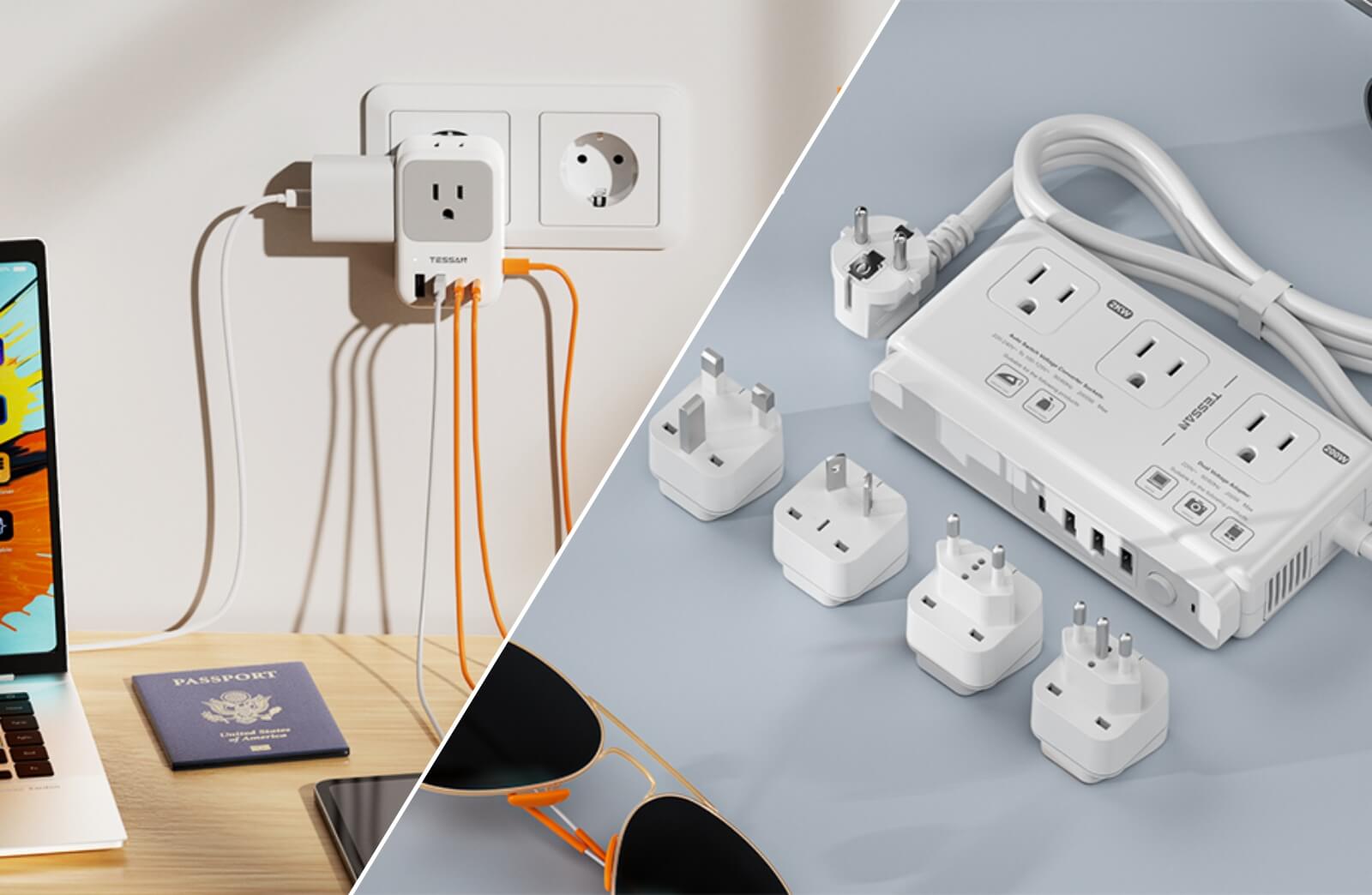

TL;DR: The world uses 15 plug types and two voltage standards (110-127V and 220-240V). Most modern electronics are dual-voltage and only need a shape adapter—but single-voltage devices like hair dryers risk damage without proper converters. This guide covers every plug type, regional quirks, and how to build a charging strategy that works in 200+ countries and regions.
Traveling internationally means confronting an uncomfortable truth: the world never agreed on how to plug things in.
At TESSAN, we've spent years engineering travel adapters and fielding customer questions from every corner of the globe. This guide distills that experience into a practical reference—covering plug types, voltage realities, and the specific regional quirks that generic guides often miss.
Two Problems, One Solution

Before diving into plug types, understand that international charging involves two distinct challenges:
The Physical Problem: Your plug's shape doesn't match the wall outlet.
The Electrical Problem: The voltage coming from that outlet may not match what your device expects.
A travel adapter solves the first problem. Whether it solves the second depends on your device—and understanding this distinction prevents the most common (and expensive) travel charging mistakes.
The World's Plug Types: What Actually Matters
The International Electrotechnical Commission recognizes 15 plug types, labeled A through O. That sounds overwhelming, but practical travel typically involves just four.
Type A & B: The Americas and Japan
The familiar flat two-prong (Type A) and grounded three-prong (Type B) used across North America, Central America, and Japan.
- Type A: Two flat parallel pins
- Type B: Two flat pins plus round grounding pin
- Voltage: 100V–127V at 60Hz
- Countries: United States, Canada, Mexico, Japan, Caribbean nations
Japan note: While plugs appear identical to US outlets, Japan operates at 100V—the world's lowest national voltage. Dual-voltage devices work fine but may charge noticeably slower than at home.
Type C: The Global Standard
Two round pins in a slim profile. This is the most widely used plug type on Earth.
- Voltage: 220V–240V at 50Hz
- Countries: Germany, France, Spain, Italy, India, South Korea, Brazil, Argentina, Indonesia, Egypt, and dozens more
For multi-country trips, Type C compatibility covers the most ground.
Type G: United Kingdom and Commonwealth
Three large rectangular pins in a triangular arrangement—unmistakable and incompatible with everything else.
- Voltage: 220V–240V at 50Hz
- Countries: United Kingdom, Ireland, Singapore, Malaysia, Hong Kong, UAE, Kenya, Nigeria
- Unique feature: Built-in fuse inside each plug (a UK safety requirement)

TESSAN Voyager 205 Universal Travel Adapter
- Compact Design, Maximum Freedom
- Charge Up to 8 Devices at Once
- Smarter GaN Tech, Cooler & Safer
- Universal Compatibility in 200+ Countries & Regions
Other Types You May Encounter
| Plug Type | Primary Countries | Description |
|---|---|---|
| Type D | India (older buildings), Nepal | 3 large round pins in triangle |
| Type E/F | France, Germany, Russia | 2 round pins + grounding clip |
| Type H | Israel | 3 pins in V-shape (Israel only) |
| Type I | Australia, New Zealand, China | 2 angled flat pins + ground |
| Type L | Italy, Chile | 3 round pins in a row |
| Type M | South Africa, India (high-power) | 3 large round pins, wide spacing |
| Type O | Thailand | 3 round pins (accepts Type C) |
Important: Many countries use multiple plug types. India uses Types C, D, and M depending on building age and region. Brazil adopted Type N in 2011 but maintains legacy Type C outlets in older properties. Research your specific accommodation, not just the country.
Voltage: The Risk That Destroys Devices

The world operates on two voltage standards:
- 110V–127V / 60Hz: North America, Japan, parts of South America and Caribbean
- 220V–240V / 50Hz: Europe, UK, Asia, Africa, Australia, most of South America
Connecting a 120V-only device to a 240V outlet doesn't simply fail to work—it forces double the expected current through the device's circuitry. Results range from immediate failure to melted components.
Checking Dual-Voltage Compatibility
Examine the input specifications on your device's power brick. Look for:
Input: 100–240V ~ 50/60Hz
That 100–240V range indicates dual-voltage compatibility. The device handles any outlet worldwide with only a shape adapter—no voltage conversion required.
Typically dual-voltage:
- Smartphone and tablet chargers
- Laptop power adapters (MacBook, Dell, Lenovo, HP, etc.)
- USB-C PD chargers
- Camera battery chargers
- Electric toothbrush bases
Typically single-voltage (requires caution):
- Hair dryers and styling tools (unless specifically marked dual-voltage)
- North American electric kettles
- Older laptop chargers
- Budget phone chargers without proper labeling
Our recommendation: For high-wattage devices like hair dryers, either purchase a dual-voltage travel version or use hotel-provided equipment. Voltage converters capable of handling 1,500W+ devices are heavy, expensive, and rarely worth the luggage space.

TESSAN 220V to 110V Voltage Converter 709
- Worldwide Use Over 200 Countries & Regions
- From 100-240V (50/60Hz) to US voltage 100-120V (60Hz)
- 6 in 1 Universal Adapter Plug Converter for Travel
- 64W USB Speed Charging
Regional Realities: What Generic Guides Miss
| Region | Plug Type(s) | Voltage | Key Notes |
|---|---|---|---|
| United Kingdom & Ireland | G | 230V | Every socket has a manual power switch—often defaulted to "off." Check the switch before troubleshooting. |
| European Union | C, E/F | 220–240V | France and Poland have recessed outlets where bulky adapters won't seat properly. Use slim-profile designs. |
| China | A, C, I | 220V | All three types may appear in the same hotel room. Newer construction favors Type I. |
| India | C, D, M | 220V | Most variable market—plug type depends on region, building age, and power requirements. Power stability varies; surge protection recommended. |
| Japan | A, B | 100V | World's lowest voltage. Dual-voltage devices work but charge slower. Ryokans often have limited outlets—multi-port adapter essential. |
| Australia & New Zealand | I | 230V | Outlets include individual switches similar to UK standards. |
| South Africa | M, C | 230V | Type M's large pins don't fit many universal adapters. Verify compatibility or plan to purchase locally. |
| Brazil | N, C | 127V or 220V | Type N standard since 2011; Type C common in older buildings. Voltage varies by region—confirm before connecting single-voltage devices. |
| Israel | H | 230V | Unique three-pin V-shape used nowhere else. Many universal adapters omit Type H—verify before travel. |
Building an Effective Travel Charging Strategy

Rather than carrying multiple single-country adapters, the modern approach uses one universal adapter paired with proper device knowledge.
What Quality Universal Adapters Provide
A well-designed universal travel adapter should offer:
- Coverage for Types A, B, C, E/F, G, and I (handles 200+ countries & regions)
- Integrated USB-A and USB-C ports for direct device charging
- USB-C Power Delivery at 20W–45W+ for fast-charging phones and laptops
- Clear wattage ratings (e.g., 10A/2,500W maximum)
- Safety certifications: FCC, CE, and UL or ETL marks indicate independent testing for overcurrent protection, short-circuit prevention, and fire resistance
- Safety shutters preventing accidental contact with live components
The Three-Device Framework
Consider the three devices requiring nightly charging:
- Phone — Benefits from USB-C PD fast charging
- Laptop or tablet — Requires AC outlet or high-wattage USB-C PD
- Secondary device — Camera battery, smartwatch, earbuds, portable speaker
A single universal adapter with one AC outlet plus multiple USB ports covers this entire charging routine without requiring power strips or outlet hunting.
Common Mistakes and Prevention

Assuming "universal" means complete coverage
Budget universal adapters frequently omit Type M (South Africa), Type H (Israel), or Type L (Italy/Chile). Verify the compatibility list before purchase.
Ignoring wattage limits
An adapter rated for 10A maximum cannot safely power a 1,500W hair dryer. At 120V, that device draws 12.5A—exceeding the adapter's capacity. Calculate requirements: Watts ÷ Voltage = Amps.
Daisy-chaining adapters
Connecting adapters in series creates resistance and heat buildup. Use one properly rated adapter per outlet, or use a travel power strip with integrated surge protection.
Overlooking frequency differences
Most electronics ignore the 50Hz vs 60Hz difference, but motorized devices (electric razors, portable fans) may operate slightly faster or slower. Not dangerous, but noticeable.

TESSAN Ultra Thin Universal Travel Adapter PD 20W
- Fast Charging with USB-C & USB-A
- 4-in-1 Travel Power Adapter
- Compact, Ultra-Thin & Travel-Ready
- Up to PD 20W max (single port)
Pre-Trip Verification Checklist
Before departure, confirm:
Your adapter covers plug types used at your destination
All devices show dual-voltage input (100–240V)
Adapter wattage rating exceeds your highest-draw device
USB-C PD available for fast-charging phones and laptops
Adapter carries recognized safety certifications
Backup charging cable packed (cables fail at inconvenient moments)
The best travel adapter isn't defined by feature count. It's the one that integrates seamlessly into your routine—plug in once, wake up to fully charged devices, repeat in every country.
That reliability is what we engineer for at TESSAN.